Wavelet transform
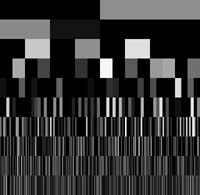
Traditional spectral decomposition techniques often fail when applied to a
self similar signal. This is due to the fact that such a signal is typically the
superposition of bursts occurring at many different timescales. Although rare,
long bursts having a very large amplitude provide much of the energy content of
the signal, while short bursts with small amplitude, although very frequent,
give small contribution to the energy of the signal. The energy is therefore
fairly well localized in time and the signal is non-stationary. This
localization prevents Fourier Analisys to work as an effective tool for this
kind of signal.
However, a scale invariant signal can be efficiently
analyzed by using the renormalization group approach devised in statistical
physics to describe systems at a critical point. The self similar system goes
through a consecutive sequence of coarse grainings which generate a new signal
with statistical properties similar to those of the original one.
Here
you can find a description of the wavelet transform.
The wavelet transform technique makes something related to renormalization group transform. It can
be used to investigate self similar processes, characterized by a 1/f
α power spectrum, also with α greater than 1. In this
case, the correlation function gives no information on the involved scaling
exponents, since it is a constant.
